The Smart Factory Advantage: Building High-Skill, High-Pay Teams in Manufacturing

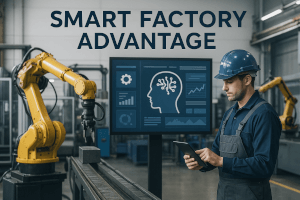
The Smart Factory Advantage: How Small Manufacturers Can Build Lean, High-Skill, High-Pay Teams That Solve Problems — Not Repeat Them
In the modern manufacturing landscape, success no longer depends on who can produce the most, but on who can adapt the fastest. For small manufacturers, the transition toward a smart factory isn’t just about new technology — it’s about transforming your workforce into a team of highly skilled problem solvers, supported by automation that handles repetitive, outdated work.
This article explores how smart factories are redefining competitiveness, why small businesses can no longer afford to wait, and practical steps to start building a smarter, leaner, and more profitable operation today.
What Is a Smart Factory?
A smart factory combines automation, real-time data, and artificial intelligence to make production systems more connected, adaptive, and self-optimizing. Machines, sensors, and systems communicate with one another, sharing information to improve quality, reduce waste, and predict maintenance needs before problems occur.
- Industrial IoT (IIoT) sensors and machine monitoring
- AI-driven predictive maintenance
- Digital twins and real-time simulation
- Robotic process automation (RPA)
- Data-driven decision dashboards
- Cloud-based manufacturing execution systems (MES)
While these sound like technologies reserved for Fortune 500 companies, small manufacturers are discovering that cloud platforms, plug-and-play IoT sensors, and AI tools have leveled the playing field.
Why Smart Factories Are a Small Business Advantage
Historically, automation required massive capital investments and IT teams. Today, subscription-based services and connected devices allow small manufacturers to start small, scale fast, and see ROI within months.
1. Replace Repetition with Problem Solving
Smart factories eliminate repetitive, low-value work through automation, freeing up skilled workers to solve high-value problems — optimizing machine setups, improving quality, reducing scrap, or fine-tuning production flow.
Lean principle: “If a machine can do it, let it — so people can innovate.”
2. Attract and Retain Highly Skilled, Highly Paid Talent
Younger generations entering manufacturing want modern tools, autonomy, and data-driven decision power. Smart factories make these roles exciting again. By integrating digital systems and cross-training workers, small businesses can offer higher wages tied to greater output, insight, and problem-solving ability, not manual repetition.
3. Real-Time Visibility and Faster Decisions
IoT-enabled smart factories collect live data from machines — uptime, part counts, energy usage, tool wear — and display them in dashboards that owners can view on any device. This visibility empowers small business leaders to:
- Identify bottlenecks instantly
- Manage multiple jobs or shifts remotely
- Predict breakdowns before they happen
- Track profitability per job in real time
4. Lean Operations and Reduced Costs
Smart manufacturing aligns perfectly with Lean principles — eliminating waste, overproduction, and inefficiency. With connected systems, every asset, material, and movement can be measured. That means less downtime, less scrap, and fewer surprises — all while reducing overtime and material waste.
How Smart Factories Will Evolve Over the Next Decade
The next evolution of the smart factory will merge AI, robotics, and real-time supply chain intelligence into one ecosystem:
- AI Predictive Workflows: Instead of reacting to issues, AI will pre-schedule maintenance, quality checks, and operator assignments.
- Autonomous Cells: Machines will communicate and coordinate directly, adjusting feeds, speeds, and setups based on live sensor data.
- Energy-Aware Manufacturing: Smart factories will balance output with power grid demand, optimizing energy costs automatically.
- Digital Twin Supply Chains: Every machine, part, and vendor will have a virtual counterpart for seamless traceability and optimization.
- AI-Driven Training: Augmented reality (AR) headsets will guide new workers through complex setups using digital overlays and voice instructions.
For small business owners, the biggest transformation will be accessibility — affordable, modular solutions that deliver enterprise-grade performance without enterprise costs.
Where Small Manufacturers Should Start
1. Start with Connectivity, Not Complexity
Before AI or robots, begin by connecting your machines. Tools like MTConnect, Free CNC monitoring systems, or affordable IIoT sensors can provide real-time data on uptime, downtime, and performance. That visibility alone can reveal bottlenecks that cost thousands in lost productivity.
2. Adopt a Lean Digital Mindset
Digitize what matters most — job tracking, machine utilization, quality checks, and preventive maintenance. Avoid getting lost in tech for tech’s sake. The goal is better decisions, not more data.
3. Train for Problem Solving, Not Button Pushing
Upskill your workforce. Invest in continuous improvement training (Kaizen, Six Sigma) and digital literacy. The goal is a high-pay, high-skill workforce that uses automation as a tool — not a threat.
4. Integrate Simple Automation
Start with low-risk automation such as pallet changers, part loaders, or automated scheduling. These provide measurable ROI while preparing teams to manage more advanced systems later.
5. Measure, Improve, and Repeat
Smart factories evolve continuously. Use your data to run experiments — reduce cycle times, optimize tool paths, or rebalance labor. Each small win compounds into big efficiency gains.
Final Thoughts: The Future Belongs to the Problem Solvers
Smart factories aren’t replacing people — they’re elevating them. In small business manufacturing, the winners of the next decade will be those who use automation to amplify human intelligence, not replace it.
By eliminating repetitive work and empowering skilled teams to innovate, small manufacturers can achieve faster throughput, higher margins, and more rewarding careers for their people.
The transition doesn’t require a massive overhaul — just a smarter, more connected way to think about your factory.